Paying in China when your card is declined
A card that works at home can fail at a Chinese till with no explanation. Here is who blocked it, and what actually unblocks it.
Why a card that works at home fails here
Four different things can stop the same payment, and they look identical on your screen:
| Who blocked it | What it looks like | What actually fixes it |
|---|---|---|
| Your bank | Declined, no reason given | Approve the transaction in your banking app, or tell them you are in China before you fly |
| The wallet (Alipay / WeChat) | Identity or risk-control prompt | Complete the passport verification; it usually wants your full legal name |
| The merchant | Works at a big shop, fails at a small one | They use a personal collection code. Ask for the shop code, or pay cash |
| The transaction type | Fails over a limit, or on a transfer | Split the payment, or switch to cash |
The three settings that cause most failures
- The name on the card must match your passport exactly. Nicknames, a missing middle name, or a shortened first name are the single most common cause. Fix that before anything else.
- Your bank needs to be told. Most foreign banks block the first large charge from China as fraud prevention. Your money is not the problem; their risk engine is.
- Every merchant may need its own approval. One successful purchase at a hotel does not guarantee a taxi or a street vendor will work.
What the fees and limits actually are
These change without much notice, so treat them as a shape, not a rule — and check the operator's own page before a large purchase:
- Under ¥200 (single transaction) the wallet absorbs the fee — you pay nothing extra. Above ¥200, a 3% charge applies to the whole transaction on an international card. This is why splitting a ¥600 purchase into three ¥200 payments costs less than one payment of ¥600, and why small shops are usually cheaper than they look.
- New cards added between now and 31 December 2026 may also get a first-90-day waiver on larger amounts — the wallet shows the current terms at the moment you pay, and that screen wins over this page.
- Single-transaction and monthly caps exist, and they differ between the two wallets.
- Both wallets are generally spend-only for foreign cards — no sending money to a person.
The backup sequence that actually works
Try the other wallet with the same card. This separates a wallet problem from a bank problem in about thirty seconds.
Try the same wallet with a different card from a different bank. This confirms whether the first bank is the blocker.
Pay cash. Keep 200-500 yuan on you at all times. It gets you through a taxi, a noodle shop and a ticket window without a single risk check.
What to say at the counter
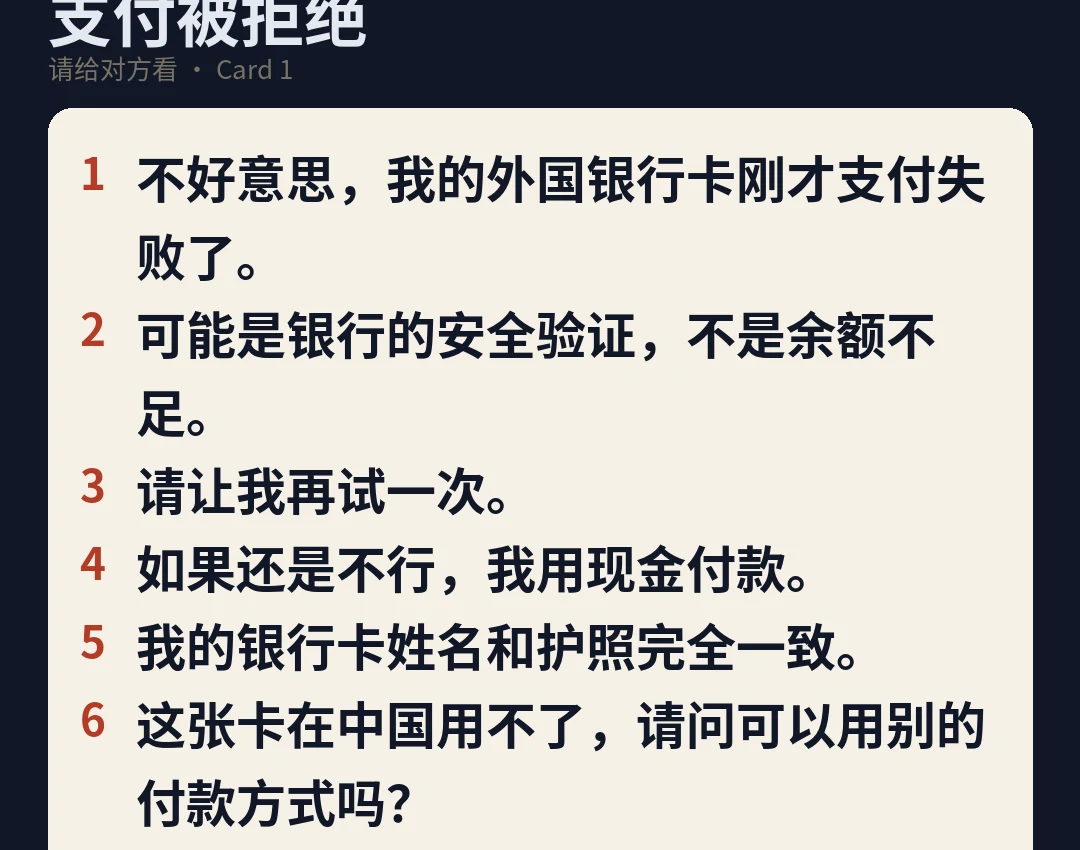
Card 1 on the main page has six numbered Chinese sentences: my card failed, it is probably a security check, let me try once more, I will pay cash, the name matches my passport, is there another way to pay. Show the Chinese side, read the English side.
Sources
Checked on 20 October 2026. Where this page and an official notice disagree, the notice wins.
Something out of date? Email d9blguanli@hotmail.com.